
Advantages of Drying Industrial Products with Microwaves
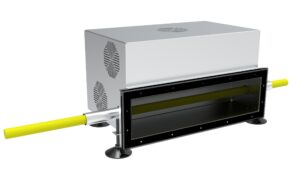 During intensive drying, products are often exposed to deformation and cracking. To ensure high final product quality, precise microwave power control is required throughout the entire process. This is no longer a challenge — MARKOM offers microwave heads with smooth power adjustment.
Most industrial dryers are designed so that the product is exposed to microwaves from two or even four sides. In such configurations, the microwave penetration depth is taken into account (the layer in which approximately 63% of the energy is absorbed). The best results are achieved when the thickness of the dried material is about twice the penetration depth.
What matters most to the user is the system's efficiency. For example: when drying gypsum boards with dimensions of 200 × 200 × 10 mm and an initial moisture content of 35–40%, the energy demand was approximately four times lower than with hot air drying.
Typical Dryer Solutions
Modern microwave dryers are divided into three main types, tailored to production needs. Chamber dryers are ideal for processing small product batches — for example, in research or laboratory testing. Conveyor belt systems are used in production lines to dry large volumes of bulk materials such as vegetables or granulates. Vacuum dryers are used for heat-sensitive products, as the boiling point of water is significantly lower under vacuum conditions.
A key advantage of microwave systems is the ability to combine multiple identical modules. This makes it possible to scale systems up to 100 kW or more. Devices operating in the 2450 ±50 MHz frequency band are approved for use worldwide.
Chamber Dryer
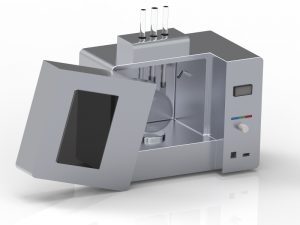 An ideal solution for testing, research, pilot batches, and small-scale production. However, there are no size limitations — from small chambers powered by a single microwave source to large-scale units with multiple emitters. Loading is done through hinged or sliding doors.
Key advantages:
- Precise control of drying parameters
- Programmable profiles for different materials
- Manual loading, making it easier to handle non-standard products
Conveyor Belt Dryer
This is the optimal solution for continuous production lines, where the material moves on a special belt resistant to high temperatures and microwave exposure. The modular design allows for different zones where microwave power is adjusted according to the process requirements, such as product moisture content.
Depending on the available space in the facility, the construction can be arranged vertically (with a bucket-type conveyor) or horizontally (with a smooth or segmented belt). Belt width ranges from 100 to 1200 mm. The feed rate depends entirely on technological needs and the drive system. For example, a drying line for mint achieves a throughput of 150 kg/h with energy consumption of just 0.35 kWh/kg.
Vacuum Dryer
This is an excellent solution for products sensitive to high temperatures. In a microwave system with vacuum technology, the boiling (evaporation) point of water is significantly lower. This protects food products from losing valuable vitamins and, in the pharmaceutical industry, prevents the degradation of active substances.
Microwave operation in a vacuum prevents the collapse of cells on the surface, facilitating water evaporation from within the product. The typical process temperature is 30–45°C. In the case of strawberries, the system retains up to 90% of antioxidants, compared to just 60% with conventional convection drying. Although the investment cost is higher, it pays off over several years due to lower energy consumption and significantly better product quality.