
Microwave Technology in the Protection of Wooden Structures
Wood is a valued construction material — it is used to produce, among other things, floors, roofs, stairs, and furniture. Unfortunately, it is susceptible to pest infestations — mainly insects that, under favorable conditions, lay eggs in the wood. After hatching, the larvae feed inside the wood structure, creating tunnels and gradually degrading its mechanical properties. This process can go unnoticed for many months or even years.
Effective Wood Heating
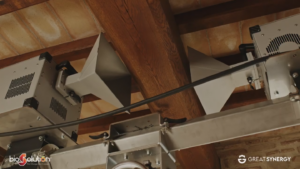 Wooden elements have a complex structure and contain many organic substances that absorb microwaves very well. Contrary to popular belief, effective microwave heating does not require wood to contain a large amount of water.
Microwave energy causes a rapid and uniform increase in temperature throughout the cross-section of the wood. When the temperature exceeds 65°C, both adult insects and their larvae, as well as eggs laid in the wood, are eliminated.
Advantages of Microwave Technology
- Effective for large cross-sections
Wood pests often hide at depths of up to 4–5 cm. Larvae create tunnels that are blocked with wood shavings. Chemical agents applied to the surface penetrate only 1–2 cm deep. When injected into holes, they get stuck at turns and in shavings, far from the larvae and eggs.
Microwaves penetrate much deeper — up to 8–10 cm — and eliminate pests throughout the entire volume of the wood.
- Efficient heating
Wood is a good insulator and therefore poorly conducts heat. As a result, it is not possible to effectively heat its interior by warming only the surface — the internal temperature does not reach insect-lethal levels.
Microwaves work differently: their energy penetrates the wood’s structure and heats it evenly. This allows the temperature to rise even in areas where pests are hiding.
- Chemical-free
Most chemical insecticides contain toxic pesticides and cannot be used in occupied spaces. Even those approved for use often require temporary evacuation of residents.
Microwave technology is safe for use in residential buildings and does not require vacating the premises. Immediately after the equipment is turned off, the rooms are ready for further use.
Microwave Devices
The set manufactured by MARKOM, combined with additional equipment, is intended for work related to the elimination of wood pests.
The latest version of the solution includes:
- two generators with adjustable power, controlled via a single touch panel,
- an electric telescopic lifter with a reach of up to 5 m,
- a mounting platform for two generators, tiltable in two planes.
We offer the possibility to configure the equipment according to the user's requirements and working conditions. The appropriate setup allows work to be carried out even in tight spaces and hard-to-reach areas.
Our devices are used by pest control companies, monument conservators, and home builders — both in Poland and abroad.
The microwave generator complies with harmonized standards and bears the CE mark, allowing it to be used throughout the European Union.
Safety
Microwaves are concentrated in the areas where the operator directs the device. Radiation outside this area is negligible and poses no risk to operators or residents. The work area is additionally monitored with a device measuring microwave power density.
The ignition temperature of wood is over 230°C — well above the temperature required to eliminate pests. A simple temperature measurement (e.g., with a pyrometer) allows for control of the process and prevents potential fire hazards.