
 Ta strona dostępna jest również w polskiej wersji językowej
Nearly 100% of buildings built before 1920 lack damp-proofing. Most buildings built before 1945 have ineffective waterproofing.
To reduce capillary rise and restore the building's functional value, thermal injection (thermowave method), a chemical injection assisted by microwaves, can be used.
Using a Microwave Generator, the wall in the injection zone is heated to approximately 80 °C. Then, a hydrophobic agent is introduced into the heated wall.
Scientific studies and technical reports indicate the effectiveness and durability of this solution.
Problem of wall moisture
Wet or heavily damp and salt-contaminated walls undergo accelerated degradation.
Wall moisture also affects thermal properties. An increase in humidity worsens the material’s thermal conductivity.
Compressive strength is reduced, and the material loses its structural properties. Once dried, the wall can recover strength close to its original state.
Secondary Wall Waterproofing
Walls with a thickness of 1–2 m are typical for many historic buildings. For most mechanical methods, such as wall undercutting or sheet insertion, they represent a significant technological limitation.
Chemical methods enable the implementation of moisture protection regardless of the wall thickness. A hydrophobic injection agent is introduced into drilled holes, angled appropriately. The injection process must take into account both the properties of the agent and the structure and technical condition of the wall.
Microwave-Assisted Chemical Injection
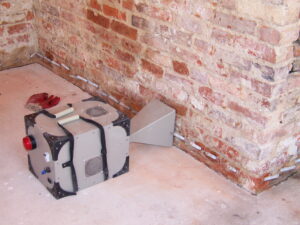 The effectiveness of injection penetration increases when the wall has a higher temperature.
The use of microwaves simultaneously heats the wall and reduces moisture in the injection zone. Due to the deep penetration of microwaves, this method is particularly effective for thick walls. This topic is described in more detail on the Drying Walls and Foundations page.
When the wall temperature is higher, hydrophobic agents penetrate more effectively into the capillaries and pores of the brick and mortar.
Typically, the injection agent is applied without pressure or under low pressure, using specialized pumps.
Advantages of Microwave-Assisted Thermal Injection
The hydrophobic barrier against capillary rise typically forms within several hours after the application of the injection agent.
Microwaves can also be used in situations where the injection is performed from the side of exposed foundations. Generators produced by MARKOM Microwaves operate equally effectively in all environmental conditions.